Overturning of walls
The Overturning of walls analysis result evaluates the local overturning stability of wall elements under the current loading conditions. It is part of the Local stability result sub-group and is used to assess whether a wall is at risk of overturning at its support.
Overturning of walls is available only for:
- Load combinations – overturning evaluation for individual load combinations
- Maximum of load combinations – envelope of overturning results from multiple combinations
Calculation prerequisites
To calculate Overturning of walls, the following conditions must be fulfilled:
- the wall must have at least one horizontal edge at the bottom
- an Edge connection must be defined for the bottom edge
The result is calculated using the resultant vertical force and resultant moment acting in the bottom edge connection.
Result meaning
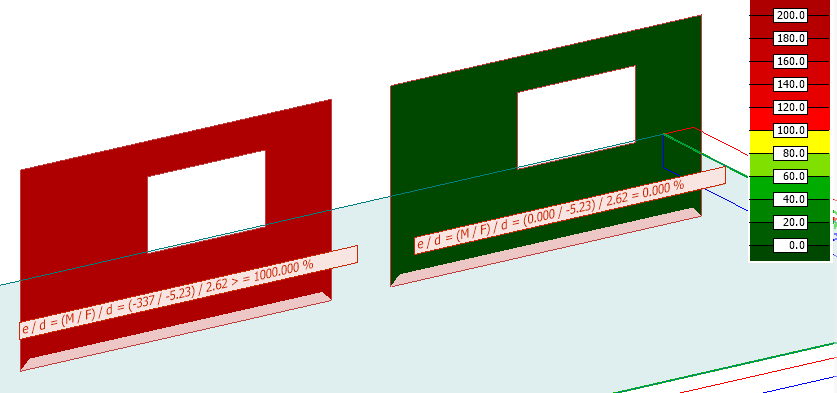
The overturning result is expressed as a percentage value that describes the position of the resultant vertical force relative to the bottom edge of the wall:
- 0 % – the resultant vertical force acts at the centre of the bottom edge
- 100 % – the resultant vertical force acts at one of the bottom edge corners
- 1000 % – the resultant vertical force acts outside the wall base
Result selection
To display Overturning of walls, you must select:
- load combination
- load combination type, such as ultimate or quasi-permanent
Only the selections relevant to this result type are shown.
Result display
Overturning of walls uses a specialised result display that is fixed for this result type.
The result is shown as a special colour palette, where colours represent the calculated overturning percentage along the wall edge.